
Introduction
Welcome to Part 4 of the AZ-900 Practice Questions series!
In the previous three parts, we covered cloud computing fundamentals, Azure networking, storage, virtual machines, identity management, security, governance, and monitoring.
In this article, we’ll continue with 25 more Microsoft Azure Fundamentals (AZ-900) practice questions, focusing on cloud service models, Azure pricing, service-level agreements, resource management, and shared responsibility.
Topics covered in this part:
- Cloud Computing Models
- Public, Private, and Hybrid Cloud
- Scalability and Elasticity
- Azure Pricing Calculator
- Service-Level Agreements (SLAs)
- Azure Resource Groups and Subscriptions
- Azure Resource Manager (ARM)
- Azure Management Groups
- Shared Responsibility Model
- Azure Regions and Region Pairs
- Azure Marketplace
- Azure Reservations
- Azure Monitor and Advisor
Each question includes the correct answer and a short explanation to help you understand the concept.
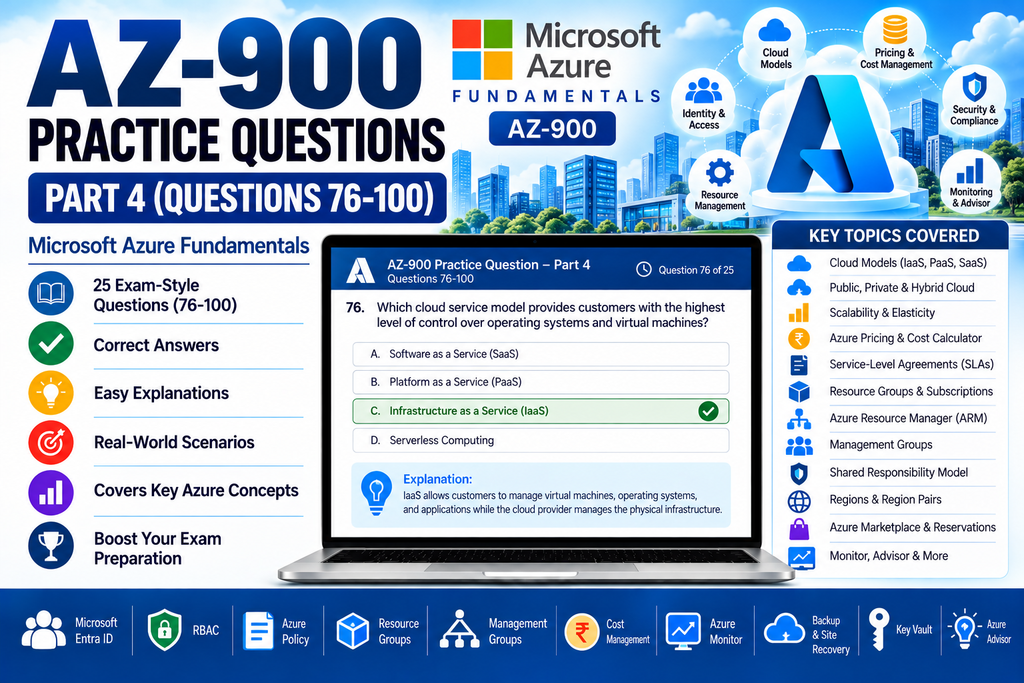
Question 76
Which cloud service model provides customers with the highest level of control over operating systems and virtual machines?
A. Software as a Service (SaaS)
B. Platform as a Service (PaaS)
C. Infrastructure as a Service (IaaS)
D. Serverless Computing
Correct Answer: C. Infrastructure as a Service (IaaS)
Explanation: IaaS allows customers to manage virtual machines, operating systems, and applications while the cloud provider manages the physical infrastructure.
Question 77
Your organization uses an on-premises datacenter and also deploys applications to Microsoft Azure.
Which cloud deployment model does this represent?
A. Public Cloud
B. Hybrid Cloud
C. Private Cloud
D. Community Cloud
Correct Answer: B. Hybrid Cloud
Explanation: A hybrid cloud combines on-premises infrastructure or private cloud environments with public cloud services.
Question 78
Which cloud computing characteristic allows resources to automatically increase or decrease based on workload demand?
A. High Availability
B. Fault Tolerance
C. Elasticity
D. Disaster Recovery
Correct Answer: C. Elasticity
Explanation: Elasticity enables resources to scale up or down dynamically according to changing workload requirements.
Question 79
Your company wants to estimate the monthly cost of running virtual machines, storage, and networking resources in Azure before deployment.
Which tool should you use?
A. Azure Advisor
B. Azure Pricing Calculator
C. Azure Monitor
D. Azure Policy
Correct Answer: B. Azure Pricing Calculator
Explanation: The Azure Pricing Calculator helps estimate the cost of Azure services based on selected configurations and expected usage.
Question 80
What does SLA stand for in Microsoft Azure?
A. Service-Level Agreement
B. Service Licensing Agreement
C. System-Level Architecture
D. Service Lifecycle Assessment
Correct Answer: A. Service-Level Agreement
Explanation: An SLA defines the service availability commitments and applicable conditions provided by Microsoft.
Question 81
An Azure service has an SLA of 99.9% availability.
Approximately how much downtime does this represent in a 365-day year?
A. 8.76 hours
B. 43.8 minutes
C. 87.6 hours
D. 4.38 hours
Correct Answer: A. 8.76 hours
Explanation: An availability of 99.9% corresponds to approximately 0.1% downtime, or 8.76 hours annually.
Question 82
Which Azure component is used to logically group related resources for management?
A. Azure Subscription
B. Azure Resource Group
C. Azure Availability Zone
D. Azure Region
Correct Answer: B. Azure Resource Group
Explanation: Resource Groups organize Azure resources so they can be managed, monitored, and governed together.
Question 83
Which Azure component serves as a primary boundary for billing and resource access management?
A. Resource Group
B. Management Group
C. Subscription
D. Availability Zone
Correct Answer: C. Subscription
Explanation: Azure subscriptions provide boundaries for billing, resource organization, and access control.
Question 84
Which Azure service enables infrastructure deployment through declarative templates?
A. Azure Monitor
B. Azure Resource Manager (ARM)
C. Azure Advisor
D. Azure Backup
Correct Answer: B. Azure Resource Manager (ARM)
Explanation: ARM supports Infrastructure as Code through declarative templates for deploying and managing Azure resources.
Question 85
What is the primary purpose of Azure Management Groups?
A. Manage individual virtual machines
B. Organize multiple Azure subscriptions for governance
C. Store application data
D. Monitor network traffic
Correct Answer: B. Organize multiple Azure subscriptions for governance
Explanation: Management Groups allow organizations to apply governance policies and access controls across multiple Azure subscriptions.
Question 86
Your company has multiple Azure subscriptions and wants them to inherit common governance policies.
Which Azure feature should you use?
A. Azure Resource Groups
B. Azure Virtual Networks
C. Azure Management Groups
D. Azure Storage Accounts
Correct Answer: C. Azure Management Groups
Explanation: Policies assigned at the Management Group level can be inherited by subscriptions and resources beneath them.
Question 87
In which cloud service model is the customer primarily responsible for managing the guest operating system?
A. Software as a Service (SaaS)
B. Platform as a Service (PaaS)
C. Infrastructure as a Service (IaaS)
D. Serverless Computing
Correct Answer: C. Infrastructure as a Service (IaaS)
Explanation: In IaaS, customers manage the guest operating system, applications, and configurations, while the cloud provider manages the underlying physical infrastructure.
Question 88
Under the Azure Shared Responsibility Model, who is responsible for the physical security of Azure datacenters?
A. Customer
B. Microsoft
C. Internet Service Provider
D. Application Developer
Correct Answer: B. Microsoft
Explanation: Microsoft is responsible for the physical security and maintenance of Azure datacenters.
Question 89
Your organization needs information about Microsoft’s compliance certifications, regulatory standards, and security commitments.
Which Microsoft resource should you use?
A. Microsoft Trust Center
B. Azure Monitor
C. Azure Advisor
D. Azure Pricing Calculator
Correct Answer: A. Microsoft Trust Center
Explanation: Microsoft Trust Center provides information about Microsoft’s security, privacy, compliance, and regulatory commitments.
Question 90
What is the primary purpose of Azure Region Pairs?
A. Reduce storage costs
B. Support disaster recovery planning and coordinated platform updates
C. Automatically encrypt data
D. Replace Azure Availability Zones
Correct Answer: B. Support disaster recovery planning and coordinated platform updates
Explanation: Azure Region Pairs support regional resilience strategies, including disaster recovery planning and certain platform update considerations.
Question 91
Which cloud financial benefit allows organizations to avoid large upfront investments in physical infrastructure?
A. Capital Expenditure (CapEx)
B. Operational Expenditure (OpEx)
C. Depreciation
D. Fixed Asset Investment
Correct Answer: B. Operational Expenditure (OpEx)
Explanation: Cloud services commonly use an OpEx model, allowing organizations to pay for resources as they consume them.
Question 92
What is the primary purpose of Azure Marketplace?
A. Monitor Azure resources
B. Discover, purchase, and deploy cloud solutions
C. Manage Azure subscriptions
D. Configure Azure DNS
Correct Answer: B. Discover, purchase, and deploy cloud solutions
Explanation: Azure Marketplace provides applications, virtual appliances, and other solutions from Microsoft and third-party vendors.
Question 93
Which Azure service provides recommendations for reducing unnecessary cloud spending?
A. Azure Advisor
B. Azure Monitor
C. Azure DNS
D. Azure Virtual Network
Correct Answer: A. Azure Advisor
Explanation: Azure Advisor identifies opportunities to optimize resource utilization and reduce costs.
Question 94
Your organization wants to enforce naming conventions and tagging standards across Azure resources.
Which Azure service should you use?
A. Azure Policy
B. Azure Monitor
C. Azure Backup
D. Azure Functions
Correct Answer: A. Azure Policy
Explanation: Azure Policy can audit or enforce resource configurations, including supported naming and tagging requirements.
Question 95
What is the primary purpose of Azure Resource Manager?
A. Store unstructured data
B. Deploy and manage Azure resources
C. Provide identity authentication
D. Monitor application performance
Correct Answer: B. Deploy and manage Azure resources
Explanation: Azure Resource Manager is the management and deployment service used to create, update, organize, and delete Azure resources.
Question 96
Your company wants to monitor the performance and health of Azure Virtual Machines.
Which service should you use?
A. Azure Monitor
B. Azure Policy
C. Azure Advisor
D. Azure Marketplace
Correct Answer: A. Azure Monitor
Explanation: Azure Monitor collects metrics and logs that help administrators analyze resource performance and health.
Question 97
Which Azure feature helps prevent accidental deletion of critical resources?
A. Azure Policy
B. Azure Resource Locks
C. Azure Advisor
D. Azure Monitor
Correct Answer: B. Azure Resource Locks
Explanation: Resource Locks can prevent accidental deletion or modification of Azure resources.
Question 98
Your organization wants to reduce the cost of eligible Azure workloads by committing to one-year or three-year usage terms.
Which Azure pricing option should you use?
A. Pay-As-You-Go
B. Azure Reservations
C. Azure Free Account
D. Spot Virtual Machines
Correct Answer: B. Azure Reservations
Explanation: Azure Reservations offer discounted pricing for eligible services when customers commit to specified terms.
Question 99
Which cloud service model requires the least infrastructure management responsibility from the customer?
A. Infrastructure as a Service (IaaS)
B. Platform as a Service (PaaS)
C. Software as a Service (SaaS)
D. Private Cloud
Correct Answer: C. Software as a Service (SaaS)
Explanation: SaaS provides fully managed applications, minimizing customer responsibility for the underlying infrastructure and platform.
Question 100
Azure operates datacenters across multiple geographic regions worldwide.
Which cloud computing benefit does this primarily provide?
A. Global Reach
B. Resource Locking
C. Data Encryption
D. Subscription Management
Correct Answer: A. Global Reach
Explanation: Azure’s global infrastructure allows organizations to deploy applications closer to users in different geographic locations.
Conclusion
Congratulations on completing Part 4 of the AZ-900 Practice Questions series (Questions 76–100)!
In this article, we explored several important Microsoft Azure fundamentals related to cloud computing models, pricing, resource management, governance, and service availability.
Some important concepts to remember:
- IaaS: Provides virtualized infrastructure with customer-managed operating systems.
- PaaS: Provides a managed platform for application development and deployment.
- SaaS: Provides ready-to-use applications with minimal infrastructure management.
- Hybrid Cloud: Combines on-premises infrastructure with public cloud services.
- Elasticity: Enables resources to automatically scale based on demand.
- Azure Pricing Calculator: Estimates Azure service costs before deployment.
- Service-Level Agreement (SLA): Defines service availability commitments.
- Azure Resource Groups: Organize related Azure resources.
- Azure Management Groups: Provide governance across multiple subscriptions.
- Azure Resource Manager: Supports resource deployment and management.
- Azure Policy: Enforces governance and compliance standards.
- Azure Advisor: Provides cost, performance, security, and reliability recommendations.
- Azure Reservations: Offer discounts for eligible committed workloads.
Understanding these concepts is important for the AZ-900 certification exam, especially when answering scenario-based questions.
Instead of memorizing definitions, focus on understanding how Azure services solve real-world business and technical requirements.
Connect with Me on LinkedIn
Thank you for reading! If you found this article helpful, connect with me on LinkedIn for more learning resources, technology insights, certification content, and career tips. Let’s learn and grow together.