
Introduction
Are you preparing for the Microsoft Azure Data Fundamentals (DP-900) certification exam?
The DP-900 certification is designed for individuals who want to understand core data concepts, relational and non-relational databases, data analytics, and Azure data services.
Whether you’re a beginner exploring databases or an IT professional looking to expand your knowledge of Azure data technologies, practicing scenario-based questions can help strengthen your understanding.
In this article, we’ll cover 25 Microsoft DP-900 practice questions with answers and explanations.
Topics Covered
- Structured, semi-structured, and unstructured data
- Relational and non-relational databases
- Transactional and analytical workloads
- OLTP and OLAP
- Batch and streaming data
- Database administrators, data engineers, and data analysts
- Primary keys and foreign keys
- Database normalization
- Indexes and views
- NoSQL databases
- Data ingestion and processing
- ETL and ELT
- Data visualization with Power BI
Each question includes four options, the correct answer, and a short explanation to help you understand the concept.
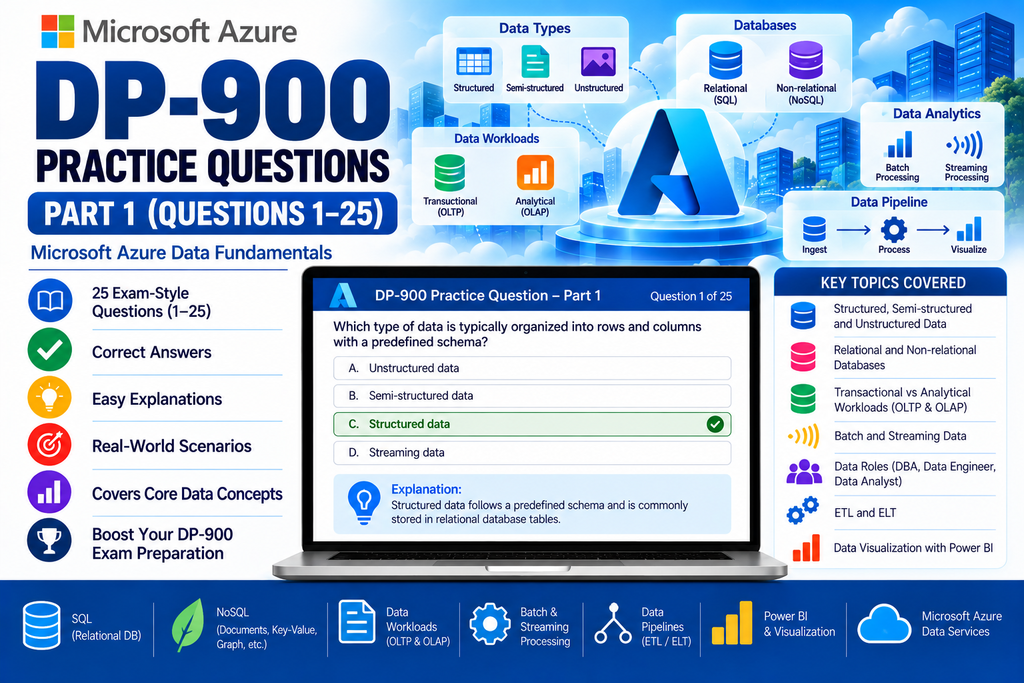
Question 1
Which type of data is typically organized into rows and columns with a predefined schema?
A. Unstructured data
B. Semi-structured data
C. Structured data
D. Streaming data
Correct Answer: C. Structured data
Explanation: Structured data follows a predefined schema and is commonly stored in relational database tables.
Question 2
Which of the following is an example of semi-structured data?
A. JPEG image
B. JSON document
C. MP4 video
D. Audio recording
Correct Answer: B. JSON document
Explanation: JSON uses keys and values to organize information without requiring the rigid table structure of a relational database.
Question 3
Your organization needs to store images, videos, and audio recordings.
Which data classification best describes these files?
A. Structured data
B. Relational data
C. Unstructured data
D. Transactional data
Correct Answer: C. Unstructured data
Explanation: Images, videos, and audio recordings are generally classified as unstructured data because their contents do not follow a predefined relational schema.
Question 4
Which type of workload is primarily designed to process frequent insert, update, and delete operations?
A. Online Analytical Processing (OLAP)
B. Online Transaction Processing (OLTP)
C. Batch Analytics
D. Data Visualization
Correct Answer: B. Online Transaction Processing (OLTP)
Explanation: OLTP systems handle day-to-day business transactions and support frequent, relatively small data operations.
Question 5
A retail company wants to analyze historical sales data to identify customer purchasing trends.
Which workload is most appropriate?
A. OLTP
B. OLAP
C. Transaction Processing
D. Database Backup
Correct Answer: B. OLAP
Explanation: OLAP workloads are optimized for analyzing large datasets, identifying trends, and supporting business decisions.
Question 6
What is the primary purpose of a relational database?
A. Store only images and videos
B. Store data in related tables
C. Execute serverless functions
D. Monitor network traffic
Correct Answer: B. Store data in related tables
Explanation: Relational databases organize data into tables and use keys to establish relationships between them.
Question 7
Which database component uniquely identifies each record in a relational table?
A. Foreign Key
B. Index
C. Primary Key
D. View
Correct Answer: C. Primary Key
Explanation: A primary key uniquely identifies each row in a table and cannot contain null values.
Question 8
A database contains two tables named Customers and Orders.
The Orders table includes a CustomerID column that references the Customers table.
What is CustomerID in the Orders table?
A. Primary Key
B. Foreign Key
C. Index
D. View
Correct Answer: B. Foreign Key
Explanation: A foreign key establishes a relationship between tables by referencing a primary or other unique key in another table.
Question 9
What is the primary purpose of database normalization?
A. Increase duplicate data
B. Reduce data redundancy and improve consistency
C. Encrypt database records
D. Automatically create database backups
Correct Answer: B. Reduce data redundancy and improve consistency
Explanation: Normalization organizes relational data to minimize duplication and reduce data inconsistencies.
Question 10
Which database object helps improve query performance by making data retrieval more efficient?
A. Index
B. Foreign Key
C. Database Backup
D. Transaction Log
Correct Answer: A. Index
Explanation: Database indexes help the database engine locate records efficiently without scanning every row.
Question 11
Which database object represents a virtual table based on the result of a SQL query?
A. Index
B. Primary Key
C. View
D. Foreign Key
Correct Answer: C. View
Explanation: A standard database view presents data returned by a query without necessarily storing a separate physical copy.
Question 12
Which SQL statement is used to retrieve data from a relational database?
A. INSERT
B. UPDATE
C. SELECT
D. DELETE
Correct Answer: C. SELECT
Explanation: The SELECT statement retrieves data from one or more database tables or views.
Question 13
Which data processing approach collects data over a period of time and processes it at scheduled intervals?
A. Streaming Processing
B. Batch Processing
C. Real-Time Processing
D. Event-Driven Processing
Correct Answer: B. Batch Processing
Explanation: Batch processing handles accumulated data at defined intervals rather than processing every event immediately.
Question 14
A company receives continuous sensor readings from thousands of IoT devices.
The readings must be processed as they arrive.
Which processing approach should the company use?
A. Batch Processing
B. Manual Processing
C. Streaming Processing
D. Scheduled Backup
Correct Answer: C. Streaming Processing
Explanation: Streaming processing handles continuously arriving data with low latency.
Question 15
Which data role is primarily responsible for managing database security, backups, access, and performance?
A. Data Analyst
B. Data Engineer
C. Database Administrator
D. Business Analyst
Correct Answer: C. Database Administrator
Explanation: Database administrators manage database availability, security, maintenance, backups, and performance.
Question 16
Which data role is primarily responsible for building data pipelines and preparing data for analytics?
A. Database Administrator
B. Data Engineer
C. Data Analyst
D. Network Administrator
Correct Answer: B. Data Engineer
Explanation: Data engineers design and maintain pipelines that ingest, transform, and prepare data for downstream analytical workloads.
Question 17
Which data role focuses on creating reports, dashboards, and visualizations to help organizations make decisions?
A. Data Engineer
B. Database Administrator
C. Data Analyst
D. System Administrator
Correct Answer: C. Data Analyst
Explanation: Data analysts transform data into meaningful insights through analysis, reporting, and visualization.
Question 18
Which Microsoft tool is primarily used to create interactive reports and data visualizations?
A. Azure Monitor
B. Power BI
C. Azure Key Vault
D. Azure Policy
Correct Answer: B. Power BI
Explanation: Power BI enables users to connect to data sources, create visualizations, and build interactive reports and dashboards.
Question 19
What does ETL stand for in data engineering?
A. Extract, Transfer, Load
B. Execute, Transform, Load
C. Extract, Transform, Load
D. Export, Transfer, Link
Correct Answer: C. Extract, Transform, Load
Explanation: ETL extracts data from source systems, transforms it into the required format, and loads it into a destination.
Question 20
What is the correct sequence of operations in an ELT process?
A. Extract → Transform → Load
B. Extract → Load → Transform
C. Execute → Load → Transfer
D. Export → Link → Transform
Correct Answer: B. Extract → Load → Transform
Explanation: ELT loads extracted data into the destination before performing transformations using the destination system’s processing capabilities.
Question 21
Which type of database is best suited for storing relationships between highly connected entities, such as social network users and their connections?
A. Relational Database
B. Graph Database
C. File Storage
D. Key-Value Database
Correct Answer: B. Graph Database
Explanation: Graph databases represent entities as nodes and relationships as edges, making them useful for highly connected data.
Question 22
Which statement best describes a NoSQL database?
A. It can store only structured tabular data
B. It always requires SQL queries
C. It supports non-relational data models and often flexible schemas
D. It cannot support large-scale applications
Correct Answer: C. It supports non-relational data models and often flexible schemas
Explanation: NoSQL databases support models such as document, key-value, graph, and column-family data.
Question 23
Which of the following is a common use case for non-relational databases?
A. Globally distributed gaming applications
B. Only traditional accounting systems
C. Only spreadsheet applications
D. Only operating system configuration
Correct Answer: A. Globally distributed gaming applications
Explanation: Non-relational databases are often used for gaming applications, user profiles, leaderboards, and workloads requiring flexible data models and low-latency access.
Question 24
What is the primary purpose of data ingestion in an analytical system?
A. Delete historical records
B. Collect and import data from different sources
C. Encrypt all database tables
D. Create user accounts
Correct Answer: B. Collect and import data from different sources
Explanation: Data ingestion collects data from source systems and moves it into storage or processing systems for further use.
Question 25
A company wants to analyze historical sales data and predict future customer demand.
Which type of analytics should it use?
A. Descriptive Analytics
B. Diagnostic Analytics
C. Predictive Analytics
D. Prescriptive Analytics
Correct Answer: C. Predictive Analytics
Explanation: Predictive analytics uses historical data and statistical or machine learning techniques to estimate future outcomes.
Conclusion
Congratulations on completing Part 1 of the DP-900 Practice Questions series (Questions 1–25)!
In this article, we explored important Microsoft Azure Data Fundamentals concepts, including data types, database models, transactional workloads, analytical processing, data engineering, and visualization.
Key Concepts to Remember
- Structured Data: Organized into predefined schemas, typically rows and columns.
- Semi-Structured Data: Uses flexible structures such as JSON.
- Unstructured Data: Includes images, audio, videos, and documents.
- OLTP: Supports day-to-day transactional operations.
- OLAP: Supports analytical queries and business intelligence.
- Relational Databases: Store data in related tables.
- NoSQL Databases: Support flexible and non-relational data models.
- Batch Processing: Processes accumulated data at scheduled intervals.
- Streaming Processing: Processes continuously arriving data.
- ETL: Extract, Transform, Load.
- ELT: Extract, Load, Transform.
- Power BI: Creates reports, dashboards, and data visualizations.
When preparing for the DP-900 certification exam, focus on understanding how different data technologies work and when they should be used.
Rather than memorizing answers, try to understand the concepts behind each question.
Connect with Me on LinkedIn
Thank you for reading! If you found this article helpful, connect with me on LinkedIn for more learning resources, technology insights, certification content, and career tips. Let’s learn and grow together.