
Introduction
Welcome to Part 3 of the AZ-900 Practice Questions series!
In Part 1 and Part 2, we covered cloud computing concepts, Azure networking, storage, virtual machines, availability zones, and important Azure services.
In this article, we’ll continue with 25 more Microsoft Azure Fundamentals (AZ-900) practice questions, focusing on identity management, security, governance, cost optimization, monitoring, and disaster recovery.
Topics covered in this part:
- Microsoft Entra ID
- Azure Role-Based Access Control (RBAC)
- Azure Policy
- Azure Resource Groups
- Azure Cost Management
- Azure Support Plans
- Azure Advisor
- Azure Backup
- Azure Site Recovery
- Azure Resource Locks
- Microsoft Defender for Cloud
- Microsoft Purview
- Azure Key Vault
- Azure Monitor
- Azure Management Groups
Each question includes the correct answer and a short explanation to help you understand the concept.
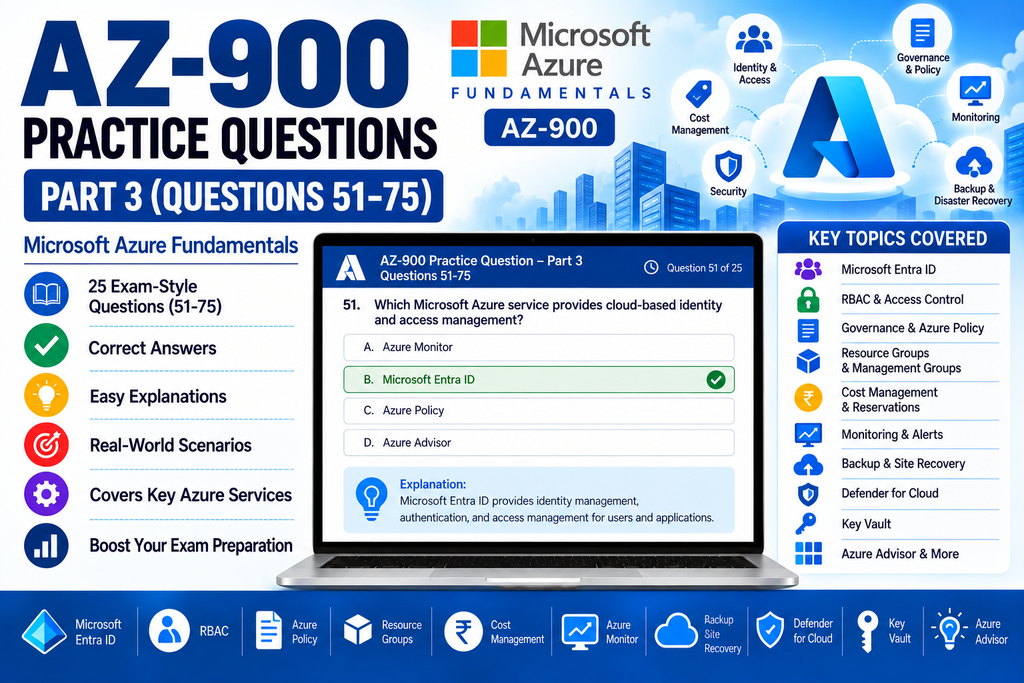
Question 51
Which Microsoft Azure service provides cloud-based identity and access management?
A. Azure Monitor
B. Microsoft Entra ID
C. Azure Policy
D. Azure Advisor
Correct Answer: B. Microsoft Entra ID
Explanation: Microsoft Entra ID provides identity management, authentication, and access management for users and applications.
Question 52
Your organization wants to ensure that users receive only the permissions necessary to perform their assigned tasks.
Which Azure feature should you use?
A. Azure Policy
B. Azure Role-Based Access Control (RBAC)
C. Azure Monitor
D. Azure Advisor
Correct Answer: B. Azure Role-Based Access Control (RBAC)
Explanation: Azure RBAC enables administrators to assign permissions based on job responsibilities and the principle of least privilege.
Question 53
Which Azure service allows organizations to enforce standards and assess compliance across Azure resources?
A. Azure Policy
B. Azure Backup
C. Azure Monitor
D. Azure Functions
Correct Answer: A. Azure Policy
Explanation: Azure Policy helps enforce organizational standards and evaluate Azure resources against compliance requirements.
Question 54
What is the primary purpose of an Azure Resource Group?
A. Store application source code
B. Organize and manage related Azure resources
C. Monitor network traffic
D. Provide authentication services
Correct Answer: B. Organize and manage related Azure resources
Explanation: Resource Groups are logical containers used to manage Azure resources throughout their lifecycle.
Question 55
Your company wants to track Azure spending and configure budgets for different departments.
Which Azure service should you use?
A. Microsoft Cost Management
B. Azure Monitor
C. Azure Advisor
D. Azure Policy
Correct Answer: A. Microsoft Cost Management
Explanation: Microsoft Cost Management provides tools to analyze cloud spending, create budgets, and monitor costs.
Question 56
Which Azure support plan is included at no additional cost for Azure customers?
A. Developer
B. Standard
C. Basic
D. Professional Direct
Correct Answer: C. Basic
Explanation: The Basic support offering provides access to billing and subscription support, while paid technical support requires an eligible paid support plan.
Question 57
Which Azure service provides personalized recommendations to improve reliability, security, performance, and operational efficiency?
A. Azure Advisor
B. Azure Monitor
C. Azure Policy
D. Azure Backup
Correct Answer: A. Azure Advisor
Explanation: Azure Advisor analyzes resource configurations and provides recommendations based on Azure best practices.
Question 58
Your organization wants to protect Azure Virtual Machines against accidental data deletion and corruption.
Which Azure service should you use?
A. Azure Backup
B. Azure Monitor
C. Azure Policy
D. Azure DNS
Correct Answer: A. Azure Backup
Explanation: Azure Backup provides backup and recovery capabilities for Azure virtual machines and other supported workloads.
Question 59
Your company wants to replicate workloads to another Azure region to support disaster recovery.
Which Azure service should you use?
A. Azure Site Recovery
B. Azure Backup
C. Azure Monitor
D. Azure Advisor
Correct Answer: A. Azure Site Recovery
Explanation: Azure Site Recovery helps maintain business continuity by replicating workloads and orchestrating failover and recovery.
Question 60
Your organization requires all Azure resources to have specific tags, such as Department and Environment.
Which Azure service should you use to enforce this requirement?
A. Azure Policy
B. Azure Monitor
C. Azure Advisor
D. Azure Backup
Correct Answer: A. Azure Policy
Explanation: Azure Policy can enforce tagging requirements by auditing or denying resources that do not meet organizational standards.
Question 61
What is the purpose of Azure Resource Locks?
A. Improve application performance
B. Prevent accidental modification or deletion of resources
C. Automatically encrypt virtual machines
D. Reduce Azure subscription costs
Correct Answer: B. Prevent accidental modification or deletion of resources
Explanation: Resource Locks help protect Azure resources from accidental deletion or modification through CanNotDelete and ReadOnly lock types.
Question 62
Which Microsoft Azure service provides security recommendations and threat protection for cloud workloads?
A. Microsoft Defender for Cloud
B. Azure Monitor
C. Azure Advisor
D. Azure DNS
Correct Answer: A. Microsoft Defender for Cloud
Explanation: Microsoft Defender for Cloud provides security posture management, security recommendations, and workload protection capabilities.
Question 63
Your organization needs to discover, classify, and govern data assets across multiple environments.
Which Microsoft service should you use?
A. Microsoft Purview
B. Azure Monitor
C. Azure Backup
D. Azure Functions
Correct Answer: A. Microsoft Purview
Explanation: Microsoft Purview provides data governance capabilities, including data discovery, classification, and cataloging.
Question 64
Which security feature requires users to provide more than one form of verification when signing in?
A. Single Sign-On (SSO)
B. Multi-Factor Authentication (MFA)
C. Role-Based Access Control (RBAC)
D. Azure Policy
Correct Answer: B. Multi-Factor Authentication (MFA)
Explanation: MFA strengthens authentication by requiring multiple verification factors, such as a password and an authenticator approval.
Question 65
Your company wants to receive alerts when CPU usage on Azure Virtual Machines exceeds a defined threshold.
Which Azure service should you use?
A. Azure Advisor
B. Azure Monitor
C. Azure Policy
D. Azure Cost Management
Correct Answer: B. Azure Monitor
Explanation: Azure Monitor supports metric-based alerts that notify administrators when monitored values exceed configured thresholds.
Question 66
Which cloud pricing model allows organizations to pay only for the resources they consume rather than purchasing hardware upfront?
A. Capital Expenditure (CapEx)
B. Operational Expenditure (OpEx)
C. Fixed Asset Model
D. Depreciation Model
Correct Answer: B. Operational Expenditure (OpEx)
Explanation: OpEx enables organizations to pay for cloud services based on consumption instead of making large upfront infrastructure investments.
Question 67
What is the primary purpose of Azure Reservations?
A. Improve network latency
B. Reduce costs for eligible workloads through usage commitments
C. Automatically back up virtual machines
D. Monitor Azure resource health
Correct Answer: B. Reduce costs for eligible workloads through usage commitments
Explanation: Azure Reservations offer discounted pricing for eligible services when organizations commit to one-year or three-year terms.
Question 68
Your company wants to compare the cost of running workloads on-premises with running them in Azure.
Which tool should you use?
A. Azure Pricing Calculator
B. Azure Total Cost of Ownership (TCO) Calculator
C. Azure Monitor
D. Azure Advisor
Correct Answer: B. Azure Total Cost of Ownership (TCO) Calculator
Explanation: The Azure TCO Calculator helps estimate potential cost savings when migrating on-premises workloads to Azure.
Question 69
Your organization wants to prevent users from deploying Azure resources outside approved geographic regions.
Which Azure service should you use?
A. Azure Monitor
B. Azure Policy
C. Azure Advisor
D. Azure Backup
Correct Answer: B. Azure Policy
Explanation: Azure Policy can restrict resource deployments to approved Azure regions by enforcing allowed-location policies.
Question 70
Which Azure service securely stores application secrets, passwords, encryption keys, and certificates?
A. Azure Key Vault
B. Azure Blob Storage
C. Azure Files
D. Azure Monitor
Correct Answer: A. Azure Key Vault
Explanation: Azure Key Vault provides secure storage and controlled access to secrets, cryptographic keys, and certificates.
Question 71
Your company wants centralized monitoring and logging for Azure resources.
Which service should you use?
A. Azure Monitor
B. Azure Policy
C. Azure Advisor
D. Azure Backup
Correct Answer: A. Azure Monitor
Explanation: Azure Monitor collects and analyzes telemetry, including logs and metrics, from Azure resources and applications.
Question 72
Your organization has multiple Azure subscriptions and wants to apply governance policies across all of them.
Which Azure feature should you use?
A. Azure Resource Groups
B. Azure Management Groups
C. Azure Virtual Networks
D. Azure Availability Zones
Correct Answer: B. Azure Management Groups
Explanation: Management Groups provide a governance hierarchy above subscriptions, allowing policies and access controls to be applied across multiple subscriptions.
Question 73
Your organization wants to configure spending budgets and receive alerts when Azure costs approach a defined limit.
Which service should you use?
A. Azure Advisor
B. Microsoft Cost Management
C. Azure Monitor
D. Azure Policy
Correct Answer: B. Microsoft Cost Management
Explanation: Microsoft Cost Management supports budget creation, cost tracking, and alerts based on configured spending thresholds.
Question 74
Your company must ensure that Azure resources comply with organizational standards and regulatory requirements.
Which Azure service should you use?
A. Azure Policy
B. Azure Backup
C. Azure Monitor
D. Azure Functions
Correct Answer: A. Azure Policy
Explanation: Azure Policy helps organizations assess and enforce resource compliance through policy definitions and assignments.
Question 75
Which Azure service helps organizations assess their cloud security posture and provides recommendations to improve security and compliance?
A. Azure Advisor
B. Microsoft Defender for Cloud
C. Azure Monitor
D. Azure DNS
Correct Answer: B. Microsoft Defender for Cloud
Explanation: Microsoft Defender for Cloud helps assess security posture, identify misconfigurations, and provide recommendations to strengthen cloud security.
Conclusion
Congratulations on completing Part 3 of the AZ-900 Practice Questions series (Questions 51–75)!
In this article, we covered several important Microsoft Azure fundamentals related to identity, security, governance, monitoring, and cost management.
Some important concepts to remember:
- Microsoft Entra ID: Provides cloud-based identity and access management.
- Azure RBAC: Controls access to Azure resources using assigned roles.
- Azure Policy: Enforces organizational standards and compliance requirements.
- Azure Resource Groups: Organize related Azure resources.
- Azure Management Groups: Provide governance across multiple subscriptions.
- Azure Monitor: Collects and analyzes logs and metrics.
- Azure Advisor: Provides recommendations for improving Azure resources.
- Microsoft Defender for Cloud: Helps improve cloud security posture.
- Azure Key Vault: Securely stores secrets, keys, and certificates.
- Azure Backup: Provides backup and recovery capabilities.
- Azure Site Recovery: Supports disaster recovery and business continuity.
- Microsoft Cost Management: Helps track and optimize Azure spending.
These concepts are important for understanding how organizations securely manage and govern their cloud infrastructure.
As you prepare for the AZ-900 certification exam, focus on understanding the purpose of each Azure service and when it should be used.
Connect with Me on LinkedIn
Thank you for reading! If you found this article helpful, connect with me on LinkedIn for more learning resources, technology insights, certification content, and career tips. Let’s learn and grow together.