
Introduction
Welcome to Part 2 of the AZ-900 Practice Questions series!
In Part 1, we covered cloud computing fundamentals, Azure storage, service models, pricing, and availability concepts.
In this article, we’ll continue with 25 more Microsoft Azure Fundamentals (AZ-900) practice questions, covering important Azure services and real-world scenarios.
Topics covered in this part:
- Azure Virtual Machines and Availability Zones
- Azure Monitor and Service Health
- Azure Storage and redundancy
- Azure IoT services
- Azure Cost Management
- Azure Networking
- Azure Functions and App Service
- Azure Databricks
- Azure DevOps and Azure Repos
- Azure Advisor
- Azure Content Delivery Network (CDN)
- Azure Machine Learning
Each question includes the correct answer and a short explanation to help you understand the concept.
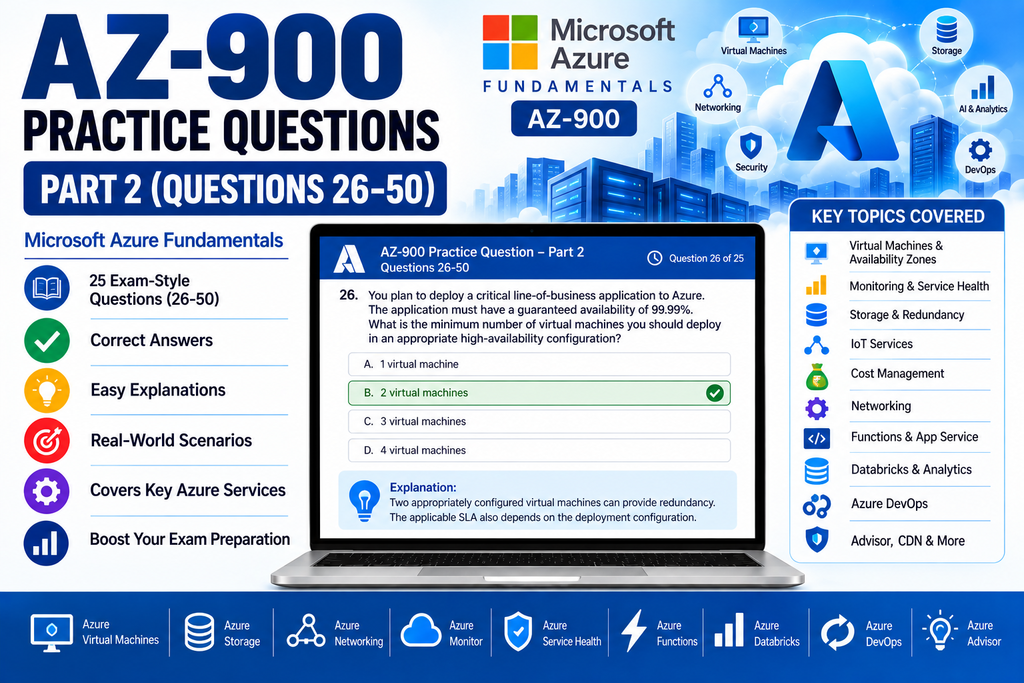
Question 26
You plan to deploy a critical line-of-business application to Azure.
The application must have a guaranteed availability of 99.99%.
What is the minimum number of virtual machines you should deploy in an appropriate high-availability configuration?
A. 1 virtual machine
B. 2 virtual machines
C. 3 virtual machines
D. 4 virtual machines
Correct Answer: B. 2 virtual machines
Explanation: Two appropriately configured virtual machines can provide redundancy. The applicable SLA also depends on the deployment configuration.
Question 27
Which Azure service should you use to collect and analyze monitoring data from multiple Azure resources in a centralized location?
A. Azure Event Hubs
B. Azure Analysis Services
C. Azure Monitor
D. Azure Stream Analytics
Correct Answer: C. Azure Monitor
Explanation: Azure Monitor collects, analyzes, and helps you act on telemetry from Azure and hybrid environments.
Question 28
An Azure Availability Zone has physically separate locations within which geographical boundary?
A. Across two continents
B. Within a single Azure region
C. Across multiple Azure regions
D. Within a single datacenter
Correct Answer: B. Within a single Azure region
Explanation: Availability Zones are physically separate groups of datacenters within an Azure region, providing fault isolation.
Question 29
Determine whether the following statements about Azure Storage are correct.
Statement 1: Data stored in an Azure Storage account automatically has at least three copies.
Statement 2: Data copied to an Azure Storage account is automatically backed up to another Azure datacenter.
Statement 3: An Azure Storage account can contain up to 2 TB of data and up to one million files.
Correct Answers:
- Yes
- No
- No
Explanation: Azure Storage maintains multiple copies for durability. Cross-datacenter replication depends on the selected redundancy option, and storage accounts support capacities greater than 2 TB.
Question 30
You need to be notified when Microsoft plans maintenance that may affect resources deployed in your Azure subscription.
Which Azure service should you use?
A. Azure Monitor
B. Azure Service Health
C. Azure Advisor
D. Azure Network Watcher
Correct Answer: B. Azure Service Health
Explanation: Azure Service Health provides personalized notifications about service issues, planned maintenance, and health advisories.
Question 31
Which of the following Azure services support Internet of Things (IoT) solutions?
A. Azure Sphere
B. Azure IoT Central
C. Azure IoT Hub
D. All of the above
Correct Answer: D. All of the above
Explanation: Azure Sphere focuses on IoT device security, IoT Central provides managed IoT application capabilities, and IoT Hub enables device-to-cloud communication.
Question 32
Your organization plans to migrate on-premises Microsoft SQL Server workloads to Azure.
You want to estimate potential cost savings from the migration.
Which tool should you use?
A. Azure Pricing Calculator
B. Azure Total Cost of Ownership (TCO) Calculator
C. Azure Advisor
D. Azure Monitor
Correct Answer: B. Azure Total Cost of Ownership (TCO) Calculator
Explanation: The Azure TCO Calculator helps compare estimated on-premises infrastructure costs with equivalent Azure deployment costs.
Question 33
Can Azure Availability Zones protect virtual machines from a complete Azure regional failure?
A. Yes
B. No
Correct Answer: B. No
Explanation: Availability Zones provide resilience against datacenter-level failures within a region. Regional disaster recovery requires a multi-region strategy.
Question 34
You plan to deploy 20 Azure virtual machines.
You must ensure that one virtual machine cannot communicate with the other virtual machines.
Which configuration should you use?
A. Deploy all virtual machines in the same subnet
B. Deploy the isolated virtual machine to a separate virtual network
C. Place all virtual machines in the same availability set
D. Assign the same network security group to all virtual machines
Correct Answer: B. Deploy the isolated virtual machine to a separate virtual network
Explanation: A separate virtual network provides network isolation by default, unless connectivity between networks is explicitly configured.
Question 35
Match each Azure service to its primary purpose.
1. Azure Cosmos DB
2. Azure HDInsight
3. Azure Synapse Analytics
A. Globally distributed NoSQL database → Big data analytics → Enterprise data analytics and warehousing
B. Enterprise data warehouse → NoSQL database → Virtual machine management
C. Web hosting → Machine learning → Data backup
D. Identity management → Network monitoring → Application hosting
Correct Answer: A
Explanation: Cosmos DB supports globally distributed database workloads, HDInsight provides managed big-data frameworks, and Synapse Analytics supports enterprise analytics and data warehousing.
Question 36
What type of failure can Azure Availability Zones primarily protect applications against?
A. Physical server failure only
B. Complete Azure region failure
C. Datacenter failure
D. Subscription deletion
Correct Answer: C. Datacenter failure
Explanation: Availability Zones isolate infrastructure across physically separate locations within an Azure region.
Question 37
You need to deploy a third-party virtual network appliance to your Azure subscription.
Which Azure service should you use?
A. Azure Subscriptions
B. Azure Security Center
C. Azure Marketplace
D. Microsoft Store
Correct Answer: C. Azure Marketplace
Explanation: Azure Marketplace provides preconfigured solutions and applications from Microsoft and third-party vendors.
Question 38
Which Azure service allows developers to execute code without managing the underlying servers?
A. Azure Virtual Machines
B. Azure Functions
C. Azure Storage
D. Azure Virtual Network
Correct Answer: B. Azure Functions
Explanation: Azure Functions provides serverless computing that executes code in response to events or triggers.
Question 39
Which Azure service is primarily designed to host web applications without requiring developers to manage virtual machines?
A. Azure Virtual Machines
B. Azure App Service
C. Azure Blob Storage
D. Azure DNS
Correct Answer: B. Azure App Service
Explanation: Azure App Service is a managed platform for hosting web applications, REST APIs, and application backends.
Question 40
Which Azure service provides event-driven serverless code execution?
A. Azure Kubernetes Service
B. Azure Virtual Machines
C. Azure Functions
D. Azure Load Balancer
Correct Answer: C. Azure Functions
Explanation: Azure Functions automatically executes code based on configured triggers, such as HTTP requests, timers, and queue messages.
Question 41
Which Azure service provides an Apache Spark-based analytics platform?
A. Azure Data Factory
B. Azure Databricks
C. Azure DevOps
D. Azure Cosmos DB
Correct Answer: B. Azure Databricks
Explanation: Azure Databricks is an Apache Spark-based analytics platform used for data engineering, analytics, and machine learning.
Question 42
Which Azure DevOps service provides Git repositories for source code version control?
A. Azure Pipelines
B. Azure Boards
C. Azure Repos
D. Azure Artifacts
Correct Answer: C. Azure Repos
Explanation: Azure Repos provides Git repositories and version-control capabilities for managing application source code.
Question 43
You need to manage Azure resources by using Azure Cloud Shell.
Which icon should you select in the Azure portal?
A. Settings icon
B. Notifications icon
C. Cloud Shell icon (>_)
D. Help icon
Correct Answer: C. Cloud Shell icon (>_)
Explanation: The Cloud Shell icon opens a browser-based command-line environment for managing Azure resources.
Question 44
You have a virtual machine named VM1 running Windows Server in the East US region.
Which Azure service should you use to view service health notifications that may affect VM1?
A. Azure Service Health
B. Azure Monitor
C. Azure Virtual Machines
D. Azure Advisor
Correct Answer: A. Azure Service Health
Explanation: Azure Service Health provides information about Azure service incidents, planned maintenance, and advisories that may affect your resources.
Question 45
Which Microsoft service provides integrated tools for source control, continuous integration, and continuous delivery?
A. Azure Monitor
B. Azure DevOps
C. Azure Storage
D. Azure Policy
Correct Answer: B. Azure DevOps
Explanation: Azure DevOps provides services such as Azure Repos, Azure Pipelines, Azure Boards, and Azure Artifacts for software development and delivery.
Question 46
Which Azure service provides recommendations for improving the reliability, security, performance, and cost efficiency of deployed resources?
A. Azure Advisor
B. Azure DNS
C. Azure Storage Explorer
D. Azure Functions
Correct Answer: A. Azure Advisor
Explanation: Azure Advisor analyzes Azure configurations and recommends improvements based on best practices.
Question 47
Your organization has an application that must automatically send email notifications when specific conditions are met.
Which Azure service should you use?
A. Azure Virtual Machines
B. Azure Marketplace
C. Azure Logic Apps
D. Azure App Service
Correct Answer: C. Azure Logic Apps
Explanation: Azure Logic Apps enables automated workflows that can send notifications and integrate applications using triggers and actions.
Question 48
Your company plans to deploy a website that will be accessed by users worldwide.
The website contains large video files, and you need to improve content delivery performance.
Which solution should you recommend?
A. Azure Application Gateway
B. Azure ExpressRoute
C. Content Delivery Network (CDN)
D. Azure Traffic Manager
Correct Answer: C. Content Delivery Network (CDN)
Explanation: A CDN caches and delivers content from locations closer to users, helping reduce latency and improve performance.
Question 49
Your company plans to deploy several million sensors that will upload data to Azure.
Which two Azure services should you consider for this solution?
A. Azure Data Lake
B. Azure Queue Storage
C. Azure File Storage
D. Azure IoT Hub
Correct Answer: A and D
Explanation: Azure IoT Hub supports communication with large numbers of connected devices, while Azure Data Lake can store and analyze large volumes of collected data.
Question 50
Your company plans to deploy an artificial intelligence solution in Azure.
You need to build, train, evaluate, and deploy predictive analytics models through a visual interface.
Which Azure tool should you use?
A. Azure Logic Apps
B. Azure Machine Learning Designer
C. Azure Batch
D. Azure Cosmos DB
Correct Answer: B. Azure Machine Learning Designer
Explanation: Azure Machine Learning Designer provides a visual interface for creating and managing machine learning pipelines.
Conclusion
Congratulations on completing Part 2 of the AZ-900 Practice Questions series (Questions 26–50)!
In this article, we explored important Microsoft Azure services and concepts related to high availability, monitoring, networking, serverless computing, big data analytics, IoT, and machine learning.
Some important concepts to remember:
- Azure Availability Zones: Protect applications against datacenter-level failures.
- Azure Service Health: Provides information about Azure service incidents and planned maintenance.
- Azure Monitor: Collects and analyzes metrics and logs.
- Azure Advisor: Provides recommendations for optimizing Azure resources.
- Azure Functions: Enables event-driven serverless computing.
- Azure App Service: Provides managed hosting for web applications.
- Azure DevOps: Supports source control, CI/CD, and development workflows.
- Azure IoT Hub: Enables communication with connected IoT devices.
- Azure Machine Learning: Supports the development and deployment of predictive models.
Understanding when to use each Azure service is essential for the AZ-900 certification exam.
Keep practicing, review the concepts behind each answer, and focus on scenario-based questions rather than memorizing service names.
Connect with Me on LinkedIn
Thank you for reading! If you found this article helpful, connect with me on LinkedIn for more learning resources, technology insights, certification content, and career tips. Let’s learn and grow together.