
Introduction
Are you preparing for the Microsoft Azure Fundamentals (AZ-900) certification exam?
The AZ-900 certification is designed for individuals who want to understand cloud computing concepts, Microsoft Azure services, pricing, governance, and security fundamentals.
In this article, we’ll cover 25 AZ-900 practice questions based on real-world scenarios and fundamental Azure concepts.
Topics covered include:
- Azure Storage and redundancy
- Cloud service models (IaaS, PaaS, SaaS)
- Azure App Service pricing tiers
- Capital and operational expenditure
- Azure Active Directory (Microsoft Entra ID)
- Azure Resource Manager templates
- Availability Zones and high availability
- Azure Functions, Blob Storage, Policy, and Advisor
Each question includes the correct answer and a short explanation to help you understand the concept.
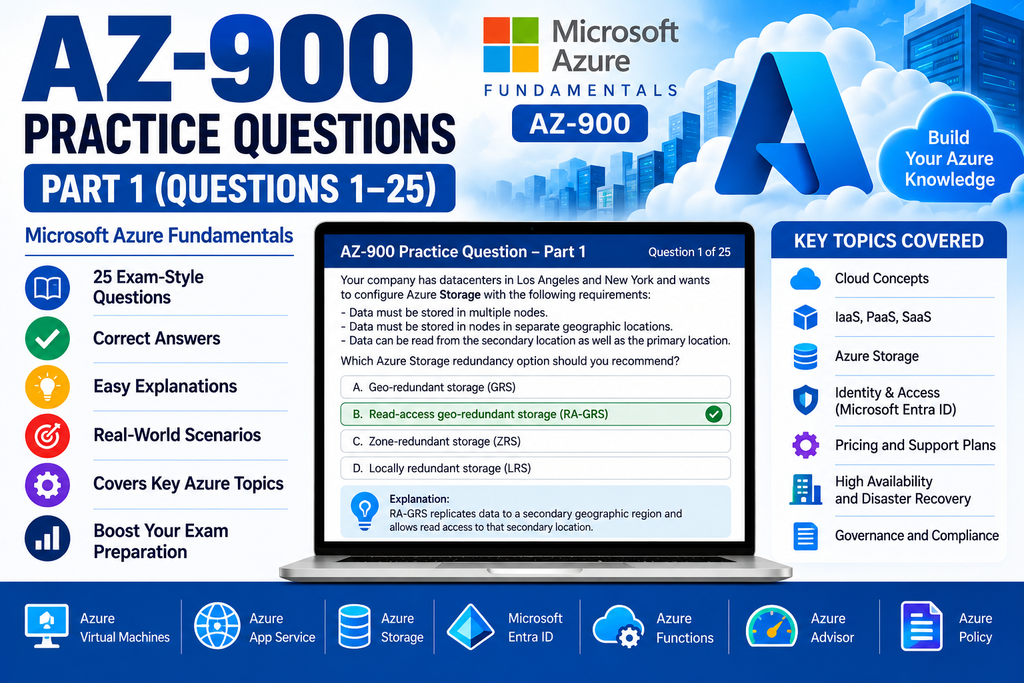
Question 1
Your company has datacenters in Los Angeles and New York and wants to configure Azure Storage with the following requirements:
- Data must be stored in multiple nodes.
- Data must be stored in nodes in separate geographic locations.
- Data can be read from the secondary location as well as the primary location.
Which Azure Storage redundancy option should you recommend?
A. Geo-redundant storage (GRS)
B. Read-access geo-redundant storage (RA-GRS)
C. Zone-redundant storage (ZRS)
D. Locally redundant storage (LRS)
Correct Answer: B. Read-access geo-redundant storage (RA-GRS)
Explanation: RA-GRS replicates data to a secondary geographic region and allows read access to that secondary location.
Question 2
Your organization currently uses the Azure Basic support plan.
You want to request a new support assessment from Microsoft and are considering upgrading to the Professional Direct support plan.
Is the Basic support plan sufficient for this requirement?
A. Yes
B. No
Correct Answer: B. No
Explanation: Basic support does not provide the proactive advisory services associated with Professional Direct support.
Question 3
You are tasked with deploying Azure Virtual Machines for your company.
You recommend using Software as a Service (SaaS).
Does this solution meet the requirement?
A. Yes
B. No
Correct Answer: B. No
Explanation: SaaS provides ready-to-use applications, whereas Azure Virtual Machines are an Infrastructure as a Service (IaaS) offering.
Question 4
You need to deploy Azure Virtual Machines.
You recommend Platform as a Service (PaaS).
Does this solution meet the requirement?
A. Yes
B. No
Correct Answer: B. No
Explanation: PaaS abstracts infrastructure management for application hosting, while Azure Virtual Machines are categorized as IaaS.
Question 5
Your organization wants to deploy and manage Azure Virtual Machines.
You recommend Infrastructure as a Service (IaaS).
Does this solution meet the requirement?
A. Yes
B. No
Correct Answer: A. Yes
Explanation: IaaS provides virtualized infrastructure, including virtual machines, networking, and storage.
Question 6
Your developers have created 10 web applications that must be hosted on Azure.
The hosting solution must meet these requirements:
- Support custom domains.
- Provide 10 GB of storage for each application.
- Use dedicated compute instances.
- Include load balancing.
- Minimize costs.
Which Azure App Service plan should you choose?
A. Standard
B. Basic
C. Free
D. Shared
Correct Answer: A. Standard
Explanation: The Standard tier supports dedicated compute, custom domains, and load balancing, with sufficient storage for the stated requirements.
Question 7
Your organization has several divisions, each with its own administrator.
You recommend creating multiple Microsoft Entra ID tenants to simplify resource administration.
Does this solution necessarily minimize administrative effort?
A. Yes
B. No
Correct Answer: B. No
Explanation: Multiple tenants introduce separate identity administration boundaries. Resource access can often be delegated within one tenant using Azure RBAC.
Question 8
Your company has developed a public web application.
The hosting solution requires:
- A custom domain
- SSL support
- Two application instances
- At least 12 GB of storage
- Minimum cost
Which App Service plan should you choose?
A. Standard
B. Basic
C. Free
D. Shared
Correct Answer: A. Standard
Explanation: Standard supports custom domains, TLS/SSL, multiple instances, and greater storage capacity than Basic.
Question 9
Your company plans to migrate virtual machines to Azure using pay-as-you-go pricing.
You recommend the elastic expenditure model as the appropriate financial classification.
Does this meet the requirement?
A. Yes
B. No
Correct Answer: B. No
Explanation: Pay-as-you-go spending is classified as operational expenditure (OpEx), not an elastic expenditure model.
Question 10
Your organization is migrating virtual machines to Azure using pay-as-you-go pricing.
You recommend the scalable expenditure model.
Is this correct?
A. Yes
B. No
Correct Answer: B. No
Explanation: Scalability is a cloud capability, while pay-as-you-go is an operational expenditure model.
Question 11
Your company plans to migrate virtual machines to Azure using pay-as-you-go pricing.
You recommend the operational expenditure model.
Does this meet the requirement?
A. Yes
B. No
Correct Answer: A. Yes
Explanation: OpEx allows organizations to pay for cloud resources as they consume them instead of purchasing infrastructure upfront.
Question 12
You need to deploy an artificial intelligence solution in Azure.
The solution must support building, testing, and deploying predictive analytics models.
You recommend Azure Cosmos DB.
Does this meet the requirement?
A. Yes
B. No
Correct Answer: B. No
Explanation: Azure Cosmos DB is a database service, not a platform primarily designed to build and train predictive machine learning models.
Question 13
Your organization has thousands of on-premises Active Directory user accounts.
You plan to migrate resources to Azure and eventually retire the on-premises datacenter.
To minimize disruption, you recommend synchronizing Active Directory accounts with Microsoft Entra ID.
Does this meet the requirement?
A. Yes
B. No
Correct Answer: A. Yes
Explanation: Directory synchronization helps maintain existing identities during migration and reduces disruption for users.
Question 14
You need an Azure service to build, train, test, and deploy predictive analytics models.
You recommend Azure Machine Learning Studio.
Does this meet the requirement?
A. Yes
B. No
Correct Answer: A. Yes
Explanation: Azure Machine Learning provides tools for developing, training, evaluating, and deploying machine learning models.
Question 15
Your organization needs to create Azure resources automatically.
You recommend Azure API Management.
Does this meet the requirement?
A. Yes
B. No
Correct Answer: B. No
Explanation: Azure API Management manages and secures APIs. It is not the primary service for automating Azure infrastructure deployments.
Question 16
Your organization wants to automate the creation of Azure resources.
You recommend Azure Management Groups.
Does this meet the requirement?
A. Yes
B. No
Correct Answer: B. No
Explanation: Management Groups organize subscriptions for governance and policy management, rather than provisioning infrastructure.
Question 17
Your company wants to automate Azure resource deployments.
You recommend Azure Resource Manager (ARM) templates.
Does this meet the requirement?
A. Yes
B. No
Correct Answer: A. Yes
Explanation: ARM templates define Azure infrastructure declaratively, allowing repeatable and automated resource deployment.
Question 18
You need to deploy a critical application in Azure with a target availability of 99.99%.
You recommend deploying two virtual machines within the same Availability Zone.
Does this meet the requirement for protection against a datacenter-level failure?
A. Yes
B. No
Correct Answer: B. No
Explanation: Two VMs in the same Availability Zone do not provide protection against failure of that entire zone.
Question 19
Your organization needs high availability for a critical Azure application.
You recommend deploying one virtual machine across two Availability Zones.
Does this meet the requirement?
A. Yes
B. No
Correct Answer: B. No
Explanation: A single virtual machine cannot simultaneously exist in two Availability Zones. Separate VMs must be deployed across zones.
Question 20
Which Azure service provides Infrastructure as a Service (IaaS) computing resources?
A. Azure App Service
B. Azure Virtual Machines
C. Azure Functions
D. Azure Logic Apps
Correct Answer: B. Azure Virtual Machines
Explanation: Azure Virtual Machines provide virtualized compute infrastructure that customers can configure and manage.
Question 21
Which Azure service provides serverless computing for executing code in response to events?
A. Azure Virtual Machines
B. Azure Functions
C. Azure Blob Storage
D. Azure Virtual Network
Correct Answer: B. Azure Functions
Explanation: Azure Functions enables event-driven code execution without requiring users to manage the underlying servers.
Question 22
Which Azure service is best suited for storing large amounts of unstructured data such as images, videos, and documents?
A. Azure SQL Database
B. Azure Blob Storage
C. Azure Virtual Machines
D. Azure DNS
Correct Answer: B. Azure Blob Storage
Explanation: Azure Blob Storage is object storage designed for large volumes of unstructured data.
Question 23
Which Azure service helps organizations enforce governance rules and compliance requirements across Azure resources?
A. Azure Monitor
B. Azure Policy
C. Azure Load Balancer
D. Azure Functions
Correct Answer: B. Azure Policy
Explanation: Azure Policy evaluates resources against organizational rules and can deny or audit noncompliant configurations.
Question 24
Which Azure service provides recommendations to improve reliability, security, performance, and cost optimization?
A. Azure Advisor
B. Azure Storage Explorer
C. Azure DNS
D. Azure Virtual Network
Correct Answer: A. Azure Advisor
Explanation: Azure Advisor analyzes deployed resources and provides recommendations based on Azure best practices.
Question 25
What is the primary benefit of using Azure Availability Zones?
A. Reduce subscription costs
B. Improve application availability and resilience
C. Automatically encrypt all application data
D. Eliminate the need for backups
Correct Answer: B. Improve application availability and resilience
Explanation: Availability Zones provide physically separate infrastructure within an Azure region to reduce the impact of datacenter failures.
Conclusion
That completes Part 1 of our AZ-900 Practice Questions series (Questions 1–25).
In this article, we covered several important Microsoft Azure fundamentals, including cloud service models, storage redundancy, App Service hosting, identity management, infrastructure automation, and high availability.
When preparing for the AZ-900 exam, focus on understanding the differences between IaaS, PaaS, and SaaS, the benefits of cloud computing, and when to use common Azure services.
Rather than memorizing answers, try to understand why each service is appropriate for a particular scenario.
Connect with Me on LinkedIn
Thank you for reading! If you found this article helpful, connect with me on LinkedIn for more learning resources, technology insights, certification content, and career tips. Let’s learn and grow together.