
Introduction
Welcome to Part 2 of the DP-900 Practice Questions series!
In Part 1, we covered core data concepts, relational and non-relational databases, transactional and analytical workloads, data processing, and data analytics fundamentals.
In this article, we’ll continue with 25 Microsoft Azure Data Fundamentals (DP-900) practice questions, focusing on relational database services available in Microsoft Azure.
Understanding the differences between Azure database services is important for the DP-900 certification exam, especially when selecting the right database solution for different business requirements.
Topics Covered
- Azure SQL Database
- Azure SQL Managed Instance
- SQL Server on Azure Virtual Machines
- Azure Database for PostgreSQL
- Azure Database for MySQL
- Platform as a Service (PaaS)
- Infrastructure as a Service (IaaS)
- Relational Database Concepts
- SQL Queries and Database Objects
- Database Security
- High Availability
- Automated Backups
- Database Migration
- Database Scalability
Each question includes four options, the correct answer, and a short explanation to help you understand the concept.
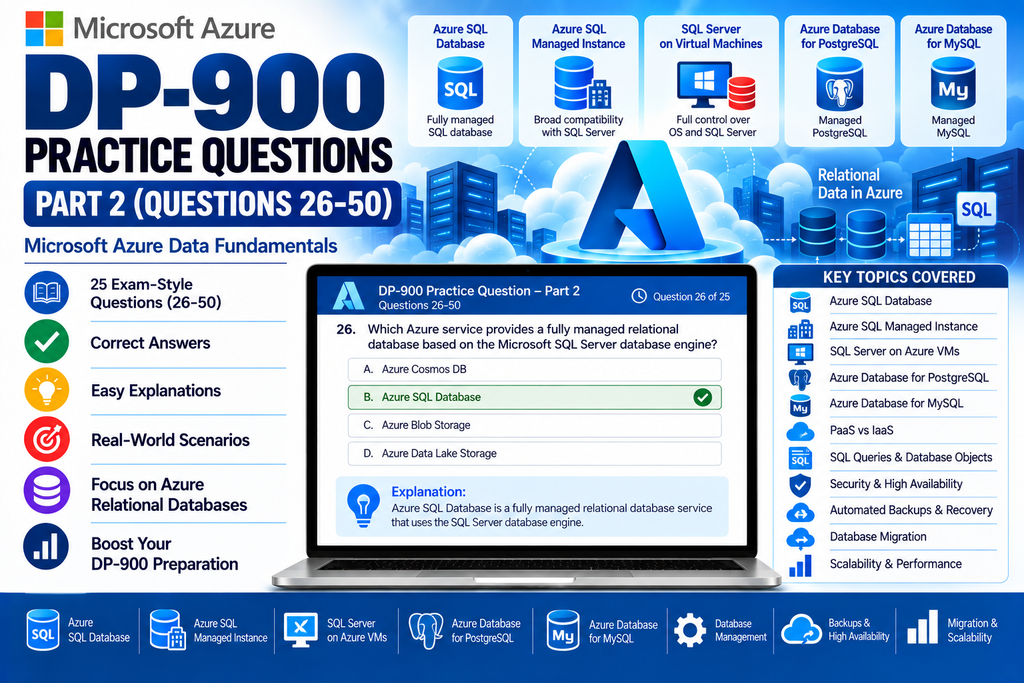
Question 26
Which Azure service provides a fully managed relational database based on the Microsoft SQL Server database engine?
A. Azure Cosmos DB
B. Azure SQL Database
C. Azure Blob Storage
D. Azure Data Lake Storage
Correct Answer: B. Azure SQL Database
Explanation: Azure SQL Database is a fully managed relational database service that uses the SQL Server database engine.
Question 27
Which cloud service model best describes Azure SQL Database?
A. Infrastructure as a Service (IaaS)
B. Software as a Service (SaaS)
C. Platform as a Service (PaaS)
D. On-premises Infrastructure
Correct Answer: C. Platform as a Service (PaaS)
Explanation: Azure SQL Database is a PaaS offering where Microsoft manages the underlying infrastructure, database software, and routine maintenance.
Question 28
Your organization wants to migrate an existing SQL Server application to Azure with minimal changes.
The application depends on SQL Server instance-level features.
Which Azure service should you consider?
A. Azure SQL Database
B. Azure SQL Managed Instance
C. Azure Cosmos DB
D. Azure Table Storage
Correct Answer: B. Azure SQL Managed Instance
Explanation: Azure SQL Managed Instance provides broad SQL Server compatibility and supports many instance-level features, making it suitable for migrations requiring minimal application changes.
Question 29
Which Azure deployment option provides the greatest control over the operating system and SQL Server installation?
A. Azure SQL Database
B. Azure SQL Managed Instance
C. SQL Server on Azure Virtual Machines
D. Azure Database for PostgreSQL
Correct Answer: C. SQL Server on Azure Virtual Machines
Explanation: SQL Server on Azure Virtual Machines provides IaaS-level control over the guest operating system and database configuration.
Question 30
Which Azure service is a managed relational database offering for PostgreSQL workloads?
A. Azure Database for PostgreSQL
B. Azure SQL Database
C. Azure Cosmos DB
D. Azure Blob Storage
Correct Answer: A. Azure Database for PostgreSQL
Explanation: Azure Database for PostgreSQL provides managed PostgreSQL database hosting with capabilities such as automated backups and high availability options.
Question 31
Your company uses MySQL for an e-commerce application.
You want to migrate the database to Azure without managing the underlying database server infrastructure.
Which service should you use?
A. Azure SQL Managed Instance
B. Azure Database for MySQL
C. Azure Cosmos DB
D. Azure Files
Correct Answer: B. Azure Database for MySQL
Explanation: Azure Database for MySQL is a managed relational database service designed for MySQL workloads.
Question 32
Which statement best describes Azure SQL Managed Instance?
A. It is a NoSQL database service
B. It provides managed SQL Server instance capabilities
C. It requires customers to manage physical servers
D. It is used exclusively for unstructured data
Correct Answer: B. It provides managed SQL Server instance capabilities
Explanation: Azure SQL Managed Instance provides a managed database environment with extensive compatibility with SQL Server features.
Question 33
Your organization wants Microsoft to handle database patching, backups, and infrastructure maintenance.
Which type of Azure database service should you choose?
A. Infrastructure as a Service (IaaS)
B. Platform as a Service (PaaS)
C. On-premises Database
D. Self-managed Virtual Machine
Correct Answer: B. Platform as a Service (PaaS)
Explanation: Managed PaaS database services reduce administrative overhead by handling infrastructure maintenance and routine database management tasks.
Question 34
Which of the following is a relational database service?
A. Azure Blob Storage
B. Azure Queue Storage
C. Azure SQL Database
D. Azure Table Storage
Correct Answer: C. Azure SQL Database
Explanation: Azure SQL Database stores structured relational data in tables and supports SQL queries.
Question 35
Which SQL statement is used to add new records to a relational database table?
A. SELECT
B. INSERT
C. UPDATE
D. DELETE
Correct Answer: B. INSERT
Explanation: The INSERT statement adds new rows to a relational database table.
Question 36
Which SQL statement is used to modify existing records in a database table?
A. SELECT
B. INSERT
C. UPDATE
D. CREATE
Correct Answer: C. UPDATE
Explanation: UPDATE modifies values in existing rows based on specified conditions.
Question 37
Which SQL statement is used to remove records from a relational database table?
A. DELETE
B. SELECT
C. ALTER
D. INSERT
Correct Answer: A. DELETE
Explanation: DELETE removes selected rows from a table without deleting the table itself.
Question 38
Which SQL command is used to create a new database table?
A. INSERT TABLE
B. CREATE TABLE
C. ADD TABLE
D. NEW TABLE
Correct Answer: B. CREATE TABLE
Explanation: CREATE TABLE defines a new table, including its columns and data types.
Question 39
Which database constraint ensures that a column cannot contain NULL values?
A. UNIQUE
B. FOREIGN KEY
C. NOT NULL
D. DEFAULT
Correct Answer: C. NOT NULL
Explanation: The NOT NULL constraint requires every row to contain a non-NULL value in the specified column.
Question 40
Which SQL clause is used to filter rows based on a condition?
A. ORDER BY
B. GROUP BY
C. WHERE
D. JOIN
Correct Answer: C. WHERE
Explanation: The WHERE clause filters rows that satisfy specified conditions.
Question 41
Which SQL clause is used to sort query results?
A. WHERE
B. ORDER BY
C. GROUP BY
D. HAVING
Correct Answer: B. ORDER BY
Explanation: ORDER BY sorts query results in ascending or descending order.
Question 42
Which SQL operation combines rows from two or more tables based on a related column?
A. JOIN
B. INSERT
C. DELETE
D. ALTER
Correct Answer: A. JOIN
Explanation: JOIN combines data from multiple tables based on specified relationships or matching conditions.
Question 43
Which Azure SQL Database capability helps protect data against accidental deletion or corruption?
A. Automated Backups
B. Azure DNS
C. Azure Load Balancer
D. Azure Virtual Network
Correct Answer: A. Automated Backups
Explanation: Azure SQL Database automatically creates backups that support database restoration within the configured retention period.
Question 44
Your organization needs to protect a relational database against datacenter failures.
Which database capability should you consider?
A. High Availability
B. SQL Views
C. Database Indexing
D. Data Normalization
Correct Answer: A. High Availability
Explanation: High availability configurations help maintain database availability during infrastructure failures, depending on the selected architecture.
Question 45
Which Azure service is most appropriate for running a legacy SQL Server application that requires full operating system access?
A. Azure SQL Database
B. Azure SQL Managed Instance
C. SQL Server on Azure Virtual Machines
D. Azure Database for MySQL
Correct Answer: C. SQL Server on Azure Virtual Machines
Explanation: SQL Server on Azure Virtual Machines allows administrators to access and configure the operating system and SQL Server installation.
Question 46
Which Azure database service supports the open-source PostgreSQL database engine?
A. Azure SQL Database
B. Azure Database for PostgreSQL
C. Azure SQL Managed Instance
D. Azure Cosmos DB
Correct Answer: B. Azure Database for PostgreSQL
Explanation: Azure Database for PostgreSQL is a managed service designed to host PostgreSQL relational databases.
Question 47
What is the primary benefit of using a managed relational database service in Azure?
A. Complete control over physical datacenter hardware
B. Reduced database administration and infrastructure management
C. Elimination of all database security responsibilities
D. Unlimited storage at no cost
Correct Answer: B. Reduced database administration and infrastructure management
Explanation: Managed database services automate many infrastructure and maintenance tasks, allowing teams to focus on applications and data.
Question 48
Which Azure database deployment option is categorized as Infrastructure as a Service (IaaS)?
A. Azure SQL Database
B. Azure SQL Managed Instance
C. SQL Server on Azure Virtual Machines
D. Azure Database for PostgreSQL
Correct Answer: C. SQL Server on Azure Virtual Machines
Explanation: SQL Server on Azure Virtual Machines is an IaaS deployment where customers manage the guest operating system and database software.
Question 49
Your company wants a managed relational database that automatically handles routine software patching.
Which Azure service should you recommend?
A. Azure SQL Database
B. SQL Server on Azure Virtual Machines
C. Azure Blob Storage
D. Azure Virtual Network
Correct Answer: A. Azure SQL Database
Explanation: Azure SQL Database is a managed PaaS offering that handles database engine updates and routine maintenance.
Question 50
Your organization wants to migrate an existing SQL Server database to Azure while retaining broad compatibility with SQL Server features and reducing infrastructure management.
Which Azure service should you recommend?
A. Azure Cosmos DB
B. Azure SQL Managed Instance
C. Azure Blob Storage
D. Azure Table Storage
Correct Answer: B. Azure SQL Managed Instance
Explanation: Azure SQL Managed Instance combines broad SQL Server compatibility with managed database infrastructure.
Conclusion
Congratulations on completing Part 2 of the DP-900 Practice Questions series (Questions 26–50)!
In this article, we explored important Microsoft Azure relational database services, SQL fundamentals, database administration, and cloud database deployment models.
Key Concepts to Remember
- Azure SQL Database: Fully managed relational database based on the SQL Server database engine.
- Azure SQL Managed Instance: Managed SQL Server instance capabilities with broad compatibility for existing SQL Server applications.
- SQL Server on Azure Virtual Machines: Provides full guest operating system and SQL Server administration control.
- Azure Database for PostgreSQL: Managed relational database service for PostgreSQL.
- Azure Database for MySQL: Managed relational database service for MySQL.
- PaaS: Reduces infrastructure administration through managed services.
- IaaS: Provides greater control over operating systems and database installations.
- Primary Keys: Uniquely identify records.
- Foreign Keys: Establish relationships between tables.
- SQL: Used to create, retrieve, update, and delete relational data.
- Automated Backups: Support database recovery.
- High Availability: Helps maintain database availability during failures.
For the DP-900 certification exam, focus on understanding when to choose Azure SQL Database, Azure SQL Managed Instance, or SQL Server on Azure Virtual Machines.
These services may use similar database technologies, but they differ significantly in management responsibilities, compatibility, and deployment flexibility.
Connect with Me on LinkedIn
Thank you for reading! If you found this article helpful, connect with me on LinkedIn for more learning resources, technology insights, certification content, and career tips. Let’s learn and grow together.