
Introduction
Welcome to Part 2 of the PL-900 Practice Questions series!
In Part 1, we explored the fundamentals of Microsoft Power Platform, including Power Apps, Power Automate, Power BI, Power Pages, Microsoft Dataverse, and AI Builder.
In this article, we’ll continue with 25 more Microsoft Power Platform Fundamentals (PL-900) practice questions, focusing on real-world business scenarios and important platform capabilities.
Topics Covered
- Power Apps and low-code development
- Canvas Apps and Model-Driven Apps
- Microsoft Dataverse
- Power Automate cloud flows
- AI Builder models
- Power BI reports and dashboards
- Power Query
- Power Platform connectors
- Business Process Flows
- Power Platform environments
- Data Loss Prevention (DLP)
- Power Platform administration
Each question includes four answer options, the correct answer, and a short explanation.
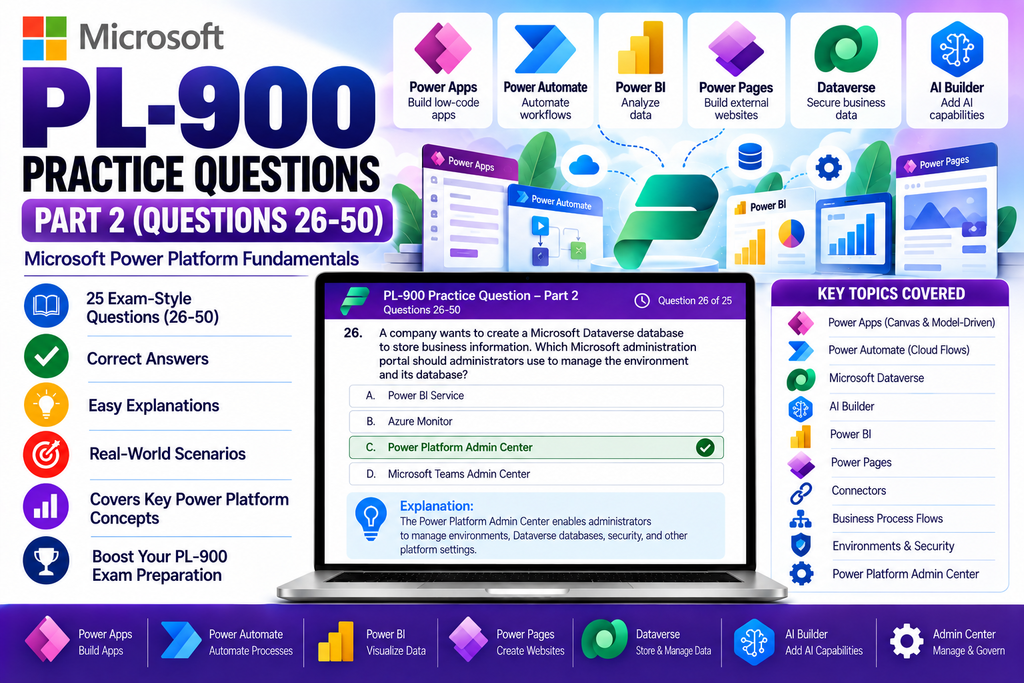
Question 26
A company wants to create a Microsoft Dataverse database to store business information.
Which Microsoft administration portal should administrators use to manage the environment and its database?
A. Power BI Service
B. Azure Monitor
C. Power Platform Admin Center
D. Microsoft Teams Admin Center
Correct Answer: C. Power Platform Admin Center
Explanation: The Power Platform Admin Center enables administrators to manage environments, Dataverse databases, security, and other platform settings.
Question 27
Which three types of AI Builder models can organizations use?
A. Linear regression, anomaly detection, and clustering
B. Prediction, object detection, and text classification
C. Virtual machine scaling, DNS management, and network routing
D. Database replication, storage backup, and load balancing
Correct Answer: B. Prediction, object detection, and text classification
Explanation: AI Builder provides AI capabilities such as prediction, object detection, and text classification that can be integrated into business applications.
Question 28
A company uses Microsoft 365 and Dynamics 365 Sales but does not have dedicated application developers.
Which two Power Platform capabilities would benefit the company?
A. Power Apps for building departmental applications and Power Automate for connecting business processes
B. Azure Virtual Machines for hosting operating systems and Azure DNS for domain management
C. Power BI for replacing all business applications and Azure Storage for user authentication
D. Microsoft Word for developing applications and Outlook for database administration
Correct Answer: A
Explanation: Power Apps allows users to build low-code business applications, while Power Automate can automate workflows across Microsoft 365 and Dynamics 365.
Question 29
A company wants to automate the approval of employee leave requests.
Which Microsoft Power Platform product should it use?
A. Power BI
B. Power Automate
C. Power Pages
D. AI Builder
Correct Answer: B. Power Automate
Explanation: Power Automate supports approval workflows that route requests to managers and notify employees of the results.
Question 30
Which Power Apps application type provides the greatest flexibility for designing custom screens and layouts?
A. Model-Driven App
B. Canvas App
C. Power BI Dashboard
D. Business Process Flow
Correct Answer: B. Canvas App
Explanation: Canvas Apps allow developers to customize the appearance, layout, and behavior of application screens.
Question 31
A company needs an application that uses Microsoft Dataverse tables, forms, views, and relationships.
Which type of Power Apps application should it create?
A. Canvas App
B. Model-Driven App
C. Power BI Report
D. Power Automate Desktop Flow
Correct Answer: B. Model-Driven App
Explanation: Model-Driven Apps use the Dataverse data model to provide structured, data-centric application experiences.
Question 32
Which Microsoft Power Platform component provides secure storage for business data in tables?
A. Power BI
B. Microsoft Dataverse
C. Power Automate
D. Power Pages
Correct Answer: B. Microsoft Dataverse
Explanation: Microsoft Dataverse stores business information in tables and supports relationships, security, and business logic.
Question 33
A company wants to automatically start a workflow whenever a new record is created in Microsoft Dataverse.
Which type of Power Automate flow should it use?
A. Scheduled cloud flow
B. Instant cloud flow
C. Automated cloud flow
D. Desktop flow
Correct Answer: C. Automated cloud flow
Explanation: Automated cloud flows start when a configured event occurs, such as the creation of a Dataverse record.
Question 34
Which type of Power Automate flow runs at a specified time or recurring interval?
A. Instant cloud flow
B. Scheduled cloud flow
C. Automated cloud flow
D. Business Process Flow
Correct Answer: B. Scheduled cloud flow
Explanation: Scheduled cloud flows execute according to a configured schedule, such as every day or every Monday.
Question 35
A manufacturing company wants to identify defective products from photographs.
Which AI Builder capability should it consider?
A. Object detection
B. Sentiment analysis
C. Language translation
D. Text classification
Correct Answer: A. Object detection
Explanation: AI Builder object detection can identify trained object categories within images, supporting visual inspection scenarios.
Question 36
A customer service team wants to classify incoming feedback as positive, negative, or neutral.
Which AI capability should it use?
A. Object detection
B. Sentiment analysis
C. Invoice processing
D. Barcode generation
Correct Answer: B. Sentiment analysis
Explanation: Sentiment analysis identifies the emotional tone expressed in text, such as positive, negative, or neutral sentiment.
Question 37
Which Power Platform capability allows users to connect applications to external services such as SharePoint, Outlook, and SQL Server?
A. Connectors
B. Business Rules
C. Power BI Bookmarks
D. Environments
Correct Answer: A. Connectors
Explanation: Connectors provide interfaces that allow Power Platform applications and flows to communicate with supported external services.
Question 38
A company needs to connect Power Apps to a REST API that does not have an existing connector.
What should the company create?
A. Power BI Dashboard
B. Custom Connector
C. Business Process Flow
D. Dataverse View
Correct Answer: B. Custom Connector
Explanation: Custom Connectors allow Power Apps and Power Automate to interact with APIs that are not supported by predefined connectors.
Question 39
A company wants to build an internal application that displays training videos and follows its corporate branding.
Which approach provides flexible control over the application interface?
A. Create a Canvas App with suitable media controls and styling
B. Create an Azure Virtual Machine
C. Create a Power BI dataset
D. Create an Azure Storage Account only
Correct Answer: A. Create a Canvas App with suitable media controls and styling
Explanation: Canvas Apps support customizable layouts and controls that can be used to build branded applications displaying supported media content.
Question 40
Which Microsoft Power Platform product is primarily designed for creating interactive reports and visualizations?
A. Power Apps
B. Power Automate
C. Power BI
D. Power Pages
Correct Answer: C. Power BI
Explanation: Power BI enables organizations to analyze information and create interactive reports and dashboards.
Question 41
A company wants to combine data from multiple sources and clean the information before creating Power BI reports.
Which tool should it use?
A. Power Query
B. Power Pages
C. Azure Key Vault
D. Power Automate Desktop
Correct Answer: A. Power Query
Explanation: Power Query provides data connection, transformation, and preparation capabilities.
Question 42
Which Power BI component provides a multi-page collection of visualizations for detailed data analysis?
A. Dashboard
B. Report
C. Workspace
D. Data Gateway
Correct Answer: B. Report
Explanation: Power BI reports can contain multiple pages with interactive charts, tables, and other visualizations.
Question 43
Which Power BI component provides a single-page view of important metrics and visualizations?
A. Dashboard
B. Dataflow
C. Semantic Model
D. Power Query
Correct Answer: A. Dashboard
Explanation: A Power BI dashboard presents important information on a single canvas using pinned visualizations.
Question 44
A company wants to control which connectors can be used together in Power Apps and Power Automate.
Which Power Platform capability should it configure?
A. Data Loss Prevention (DLP) Policies
B. Power BI Bookmarks
C. Canvas App Themes
D. Business Process Flows
Correct Answer: A. Data Loss Prevention (DLP) Policies
Explanation: DLP policies help organizations govern how connectors are used and reduce the risk of inappropriate data sharing.
Question 45
A retail organization wants a single-page overview of sales, revenue, and store performance indicators.
Which Power BI component should it use?
A. Dashboard
B. Data Gateway
C. Custom Connector
D. Dataverse Table
Correct Answer: A. Dashboard
Explanation: A Power BI dashboard combines key visualizations into a single-page view for monitoring business performance.
Question 46
A company wants employees to follow a consistent sequence of stages when processing customer sales opportunities.
Which Power Platform capability should it use?
A. Business Process Flow
B. Power BI Dashboard
C. Azure Monitor
D. Power Query
Correct Answer: A. Business Process Flow
Explanation: Business Process Flows guide users through defined business stages and steps, helping standardize processes.
Question 47
Which Power Platform feature allows organizations to separate development, testing, and production resources?
A. Business Rules
B. Environments
C. Power BI Reports
D. AI Builder Models
Correct Answer: B. Environments
Explanation: Power Platform environments provide separate spaces for applications, flows, data, and other platform resources.
Question 48
Which Microsoft Power Platform product allows organizations to create external-facing business websites?
A. Power BI
B. Power Automate
C. Power Pages
D. Power Apps Desktop
Correct Answer: C. Power Pages
Explanation: Power Pages provides low-code capabilities for creating secure business websites accessible to external users.
Question 49
A company wants to apply validation logic to fields in Microsoft Dataverse without writing custom code.
Which capability should it use?
A. Business Rules
B. Power BI Dashboards
C. Azure Virtual Machines
D. Power Automate Desktop
Correct Answer: A. Business Rules
Explanation: Dataverse Business Rules can implement supported validation and field-level logic through a low-code interface.
Question 50
A retail company stores store names and store numbers in one Power BI table.
Sales transactions are stored in another table, and each transaction contains a store number.
The company needs to prepare the data so reports can display store names alongside sales transactions.
Which tool can be used to merge the tables during data preparation?
A. Power Query Editor
B. Power BI Service Dashboard
C. Microsoft Outlook
D. Power Automate Approvals
Correct Answer: A. Power Query Editor
Explanation: Power Query Editor can merge tables using matching columns, such as Store Number, so the resulting data includes the corresponding store names.
Conclusion
Congratulations on completing Part 2 of the PL-900 Practice Questions series (Questions 26–50)!
In this article, we explored important Microsoft Power Platform concepts related to low-code development, workflow automation, artificial intelligence, reporting, and administration.
Key Concepts to Remember
- Power Apps: Build low-code business applications.
- Canvas Apps: Provide flexible screen layouts and custom interfaces.
- Model-Driven Apps: Create data-centric applications using Dataverse.
- Microsoft Dataverse: Store and manage business data.
- Power Automate: Automate repetitive tasks and business workflows.
- Automated Cloud Flows: Run when specified events occur.
- Scheduled Cloud Flows: Run at configured times.
- AI Builder: Add AI capabilities to business applications.
- Power BI: Create interactive reports and dashboards.
- Power Query: Clean, transform, and combine data.
- Custom Connectors: Integrate external APIs.
- DLP Policies: Govern connector usage and data sharing.
- Business Process Flows: Guide users through defined business stages.
- Power Platform Environments: Separate application lifecycle environments.
- Power Pages: Build external-facing business websites.
When preparing for the PL-900 certification exam, focus on understanding which Power Platform product or feature best fits a specific business requirement.
Understanding real-world scenarios is more useful than simply memorizing product names.
Connect with Me on LinkedIn
Thank you for reading! If you found this article helpful, connect with me on LinkedIn for more learning resources, technology insights, certification content, and career tips. Let’s learn and grow together.