
Introduction
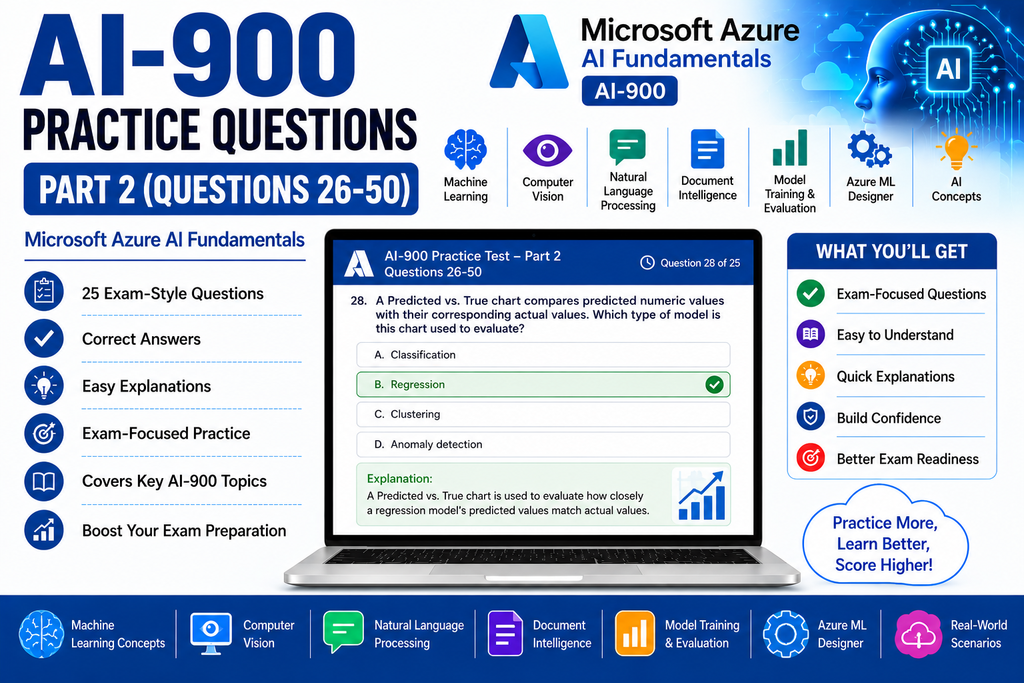
Welcome to Part 2 of the AI-900 Practice Questions series.
In Part 1, we covered the foundations of artificial intelligence, responsible AI, computer vision, natural language processing, and basic machine learning concepts.
In this part, we’ll continue with Questions 26–50, focusing more deeply on:
- Machine Learning concepts
- Features and labels
- Regression and classification
- Clustering
- Automated Machine Learning
- Model training and evaluation
- Azure Machine Learning Designer
- Document processing
- Custom Vision
- Validation datasets
Each question includes the correct answer and a short explanation to make revision easier.
Question 26
Match the machine learning task with the appropriate scenario.
- Examining the values of a confusion matrix
- Splitting a date into month, day, and year fields
- Picking temperature and pressure to train a weather model
A. Model evaluation → Feature engineering → Feature selection
B. Feature engineering → Model evaluation → Feature selection
C. Feature selection → Feature engineering → Model evaluation
D. Model training → Feature selection → Feature engineering
Answer: A
Explanation: A confusion matrix is used for model evaluation, deriving fields from existing data is feature engineering, and choosing useful inputs is feature selection.
Question 27
Data values that influence the prediction of a machine learning model are called:
A. Dependent variables
B. Features
C. Identifiers
D. Labels
Answer: B. Features
Explanation: Features are input values used by a machine learning model to make predictions.
Question 28
A Predicted vs. True chart compares predicted numeric values with their corresponding actual values.
Which type of model is this chart used to evaluate?
A. Classification
B. Regression
C. Clustering
D. Anomaly detection
Answer: B. Regression
Explanation: A Predicted vs. True chart is used to evaluate how closely a regression model’s predicted values match actual values.
Question 29
Which type of machine learning should you use to predict the number of gift cards that will be sold next month?
A. Classification
B. Regression
C. Clustering
D. Anomaly detection
Answer: B. Regression
Explanation: Regression is used when the value being predicted is numerical.
Question 30
You have a dataset containing information about taxi journeys.
You need to train a model to predict the fare of a taxi journey.
Which should you use as a feature?
A. Number of taxi journeys in the dataset
B. Trip distance of an individual journey
C. Fare of the individual journey
D. Trip ID
Answer: B. Trip distance of an individual journey
Explanation: Trip distance is an input that can influence the fare, while the fare itself is the label being predicted.
Question 31
You need to predict the sea level in meters for the next 10 years.
Which type of machine learning should you use?
A. Classification
B. Regression
C. Clustering
D. Anomaly detection
Answer: B. Regression
Explanation: Sea level is a continuous numerical value, making regression appropriate.
Question 32
For each statement about Automated Machine Learning, select Yes or No.
Statement 1: Automated ML automates time-consuming and iterative machine learning development tasks.
Statement 2: Automated ML can automatically infer the training data from the use case provided.
Statement 3: Automated ML can run multiple training iterations that are scored and ranked using specified metrics.
Statement 4: Automated ML can automatically determine which label should be predicted without the user specifying it.
Answers:
- Yes
- No
- Yes
- No
Explanation: Automated ML automates model training and tuning, but the appropriate training data and target label still need to be provided.
Question 33
A banking system predicts whether a loan will be repaid.
Which type of machine learning is this?
A. Classification
B. Regression
C. Clustering
D. Reinforcement learning
Answer: A. Classification
Explanation: The outcome is categorical—for example, repaid or not repaid—so this is classification.
Question 34
Determine whether each statement is correct.
Statement 1: Labeling is the process of tagging training data with known values.
Statement 2: You should evaluate a model using the same data that was used to train it.
Statement 3: Accuracy is always the primary metric used to measure a model’s performance.
Answers:
- Yes
- No
- No
Explanation: Labeled data contains known target values, evaluation should use separate data, and the appropriate evaluation metric depends on the machine learning problem.
Question 35
Which service should you use to automatically extract text, key/value pairs, and tables from scanned documents?
A. Form Recognizer
B. Text Analytics
C. Language Understanding
D. Custom Vision
Answer: A. Form Recognizer
Explanation: Form Recognizer is designed to extract structured information such as text, key/value pairs, and tables from documents.
Question 36
The ability to extract subtotals and totals from a receipt is a capability of which service?
A. Custom Vision
B. Form Recognizer
C. Ink Recognizer
D. Text Analytics
Answer: B. Form Recognizer
Explanation: Form Recognizer can extract structured information from documents such as invoices, forms, and receipts.
Question 37
You use Azure Machine Learning Designer to publish an inference pipeline.
Which two parameters should you use to access the web service?
A. Model name
B. Training endpoint
C. Authentication key
D. REST endpoint
Answer: C and D
Explanation: The supplied material identifies the authentication key and REST endpoint as the information needed to consume the published service.
Question 38
According to the supplied practice material, where should a real-time inference pipeline from Azure Machine Learning Designer be deployed for others to consume?
A. Local web service
B. Azure Container Instances
C. Azure Kubernetes Service (AKS)
D. Azure Machine Learning compute
Answer: C. Azure Kubernetes Service (AKS)
Explanation: The source material identifies AKS as the deployment target for production real-time inference pipelines.
Question 39
Predicting how many hours of overtime a delivery person will work based on the number of orders received is an example of:
A. Classification
B. Clustering
C. Regression
D. Anomaly detection
Answer: C. Regression
Explanation: The model predicts a numerical quantity—the number of overtime hours—so regression is appropriate.
Question 40
Which statements about Azure Machine Learning Designer are correct?
Statement 1: It lets you visually connect datasets and modules on an interactive canvas.
Statement 2: Connected modules can be used to create a pipeline draft.
Statement 3: Azure Machine Learning Designer is used only through Python code.
Answers:
- Yes
- Yes
- No
Explanation: Azure Machine Learning Designer provides a visual interface for building machine learning pipelines.
Question 41
You want to train a model that predicts a house’s price category.
The dataset contains:
- Household Income
- House Price Category
What are these fields?
A. Household Income = Label; House Price Category = Feature
B. Household Income = Feature; House Price Category = Label
C. Both are labels
D. Both are features
Answer: B
Explanation: Household Income is an input feature, while House Price Category is the output the model needs to predict.
Question 42
In a machine learning model, what is the value that the model is trained to predict called?
A. Feature
B. Label
C. Cluster
D. Dataset
Answer: B. Label
Explanation: A label is the target value that a supervised machine learning model attempts to predict.
Question 43
Determine whether each statement about Automated Machine Learning is correct.
Statement 1: Automated ML allows custom Python scripts to be included directly in a training pipeline through its no-code experience.
Statement 2: Automated ML can implement machine learning solutions without requiring programming experience.
Statement 3: Automated ML provides the same visual module-connection canvas used by Azure Machine Learning Designer.
Answers:
- No
- Yes
- No
Explanation: According to the supplied material, Automated ML provides a no-code experience, while visually connecting datasets and modules is associated with Azure Machine Learning Designer.
Question 44
A medical research project has a large dataset of brain scan images already categorized into predefined brain hemorrhage types.
You need a machine learning model to identify the type represented by a new brain scan.
Which type of machine learning should you use?
A. Clustering
B. Regression
C. Classification
D. Anomaly detection
Answer: C. Classification
Explanation: The model selects from predefined categories using labeled training data, making this a classification problem.
Question 45
When training a machine learning model, why should you randomly split rows into separate subsets?
A. To train the model twice for better accuracy
B. To train multiple models simultaneously
C. To test the model using data that was not used during training
D. To reduce the number of features
Answer: C
Explanation: A separate test dataset lets you evaluate how well the model performs on previously unseen data.
Question 46
The supplied material discusses legacy Basic and Enterprise Azure Machine Learning workspaces.
Which two tasks did the material identify as requiring an Enterprise workspace?
A. Use a GUI to run automated machine learning experiments
B. Create a compute instance
C. Use Azure Machine Learning Designer through a GUI
D. Create a dataset from a CSV file
Answer: A and C
Explanation: The source lists GUI-based Automated ML and Designer as Enterprise-workspace capabilities, while also noting that the Enterprise workspace distinction was later retired.
Question 47
You need to predict a customer’s income range.
The dataset contains:
- First Name
- Last Name
- Age
- Education Level
- Income Range
Which two fields should you use as useful features?
A. Education Level
B. Last Name
C. Age
D. Income Range
E. First Name
Answer: A and C
Explanation: Age and education level can help predict income, while Income Range is the label and names are not useful predictive features in this scenario.
Question 48
You are building a tool that processes images from retail stores and identifies competitors’ products using a custom model.
Which service should you use according to the supplied material?
A. Custom Vision
B. Form Recognizer
C. Face
D. Computer Vision
Answer: A. Custom Vision
Explanation: Custom Vision enables you to train an image model using your own labels to recognize specific objects or categories.
Question 49
Determine whether each scenario is an example of clustering.
Statement 1: Organizing documents into groups based on similarities in their text.
Statement 2: Grouping similar patients based on symptoms and diagnostic-test results.
Statement 3: Predicting whether a person will develop mild, moderate, or severe allergy symptoms based on pollen count.
Answers:
- Yes
- Yes
- No
Explanation: Clustering groups similar data without predicting predefined labels. Predicting a predefined allergy-severity category is not clustering.
Question 50
Determine whether each statement about a validation dataset is correct.
Statement 1: A validation set includes the input examples used to train the model.
Statement 2: A validation set can help determine how well a model predicts labels.
Statement 3: A validation set is used to verify that all training data was used to train the model.
Answers:
- No
- Yes
- No
Explanation: A validation dataset is separate from training data and is used to estimate model performance during model development.
Conclusion
That completes AI-900 Practice Questions Part 2 — Questions 26–50.
This section focused heavily on the machine learning concepts you should understand for AI-900:
Features → Input values used to make predictions
Labels → Values the model attempts to predict
Regression → Predict numerical values
Classification → Predict predefined categories
Clustering → Group similar items without predefined labels
Feature Engineering → Create or transform useful features
Feature Selection → Select the most relevant features
Model Evaluation → Measure how well a trained model performs
We also covered Azure Machine Learning, Automated ML, Machine Learning Designer, document processing, and custom image recognition.
Connect with Me on LinkedIn
Thank you for reading! If you found this article helpful, connect with me on LinkedIn for more learning resources, technology insights, certification content, and career tips. Let’s learn and grow together.